Type 1
Salt & algae film
The green-gray slick that forms in low-flow canals. Lifts easily with marine cleaner and soft agitation — if caught early.
★ 5.0 on Google Licensed & Insured Owner-Operated by Kevin Gardner
24.9477° N, 80.6079° W · Islamorada, FL
Above-Waterline · Dock or Lift · No Haul-Out
The waterline band is where salt film, algae, tannin staining and rust weep collect first — and where a clean boat starts looking tired. We remove it all at your dock or on your lift, with surface-safe chemistry and full neutralization.
2–3 hour typical visit Rust weep treated at the track Service updates when useful
Know Your Enemy
Four different kinds of buildup show up in Keys slips — and each needs different chemistry. Misdiagnosing them is why DIY waterline jobs streak.
Type 1
The green-gray slick that forms in low-flow canals. Lifts easily with marine cleaner and soft agitation — if caught early.
Type 2
Brown banding from mangrove tannins and stirred sediment. Needs stain remover with dwell time, not scrubbing force.
Type 3
Orange streaks running down from rails, hinges or cleats. We lift the track and note the source fitting so it stops recurring.
Type 4
Black film near the transom from generator or outboard exhaust. Degreaser-first process, then stain treatment.
And sometimes it isn't a stain at all. Chalky, dull patches that won't lift are oxidized gelcoat — that's a correction job, not a cleaning job. We'll tell you which one you're looking at before quoting.
Every Waterline Service
Straight Talk
Below the waterline is a diver's or yard's job, and pretending otherwise is how gelcoat and bottom paint get damaged. We own everything you can see from the dock — and we'll point you to a reputable diver for the rest.
Firm before we start: a daylight photo of the waterline band is usually all we need to quote severity accurately. You get the scope in writing before we schedule — and pair it with a wash & wax and the whole hull reads fresh in one visit.
The Process
Film, tannin, weep or soot — each gets matched chemistry. Decals, stripes and hardware are noted and masked where needed.
Loose material removed first so cleaners work on bonded stain, not surface sludge.
Surface-safe marine stain remover applied to the band with controlled dwell time — chemistry does the work, not pressure.
Soft to medium pads or brushes selected per finish. Rust weep tracks get targeted rust remover and repeat dwell as needed.
Full neutralization and fresh rinse — no active chemistry left on gelcoat, fittings or in the bilge path.
Cleaned band waxed or sealed to slow reattachment, completion photos sent, and any weep sources or soft spots noted in writing.
Dock-Level Proof
Standing on the dock, the waterline is eye level — it's the first thing guests, buyers and surveyors look at. This Sea Ray 340 came in with a season of canal film and weep tracks; one visit later the band matched the topsides.
Listing a boat? A clean waterline photographs dramatically better than any filter. It's one of the cheapest sale-prep wins available.
Sale preparation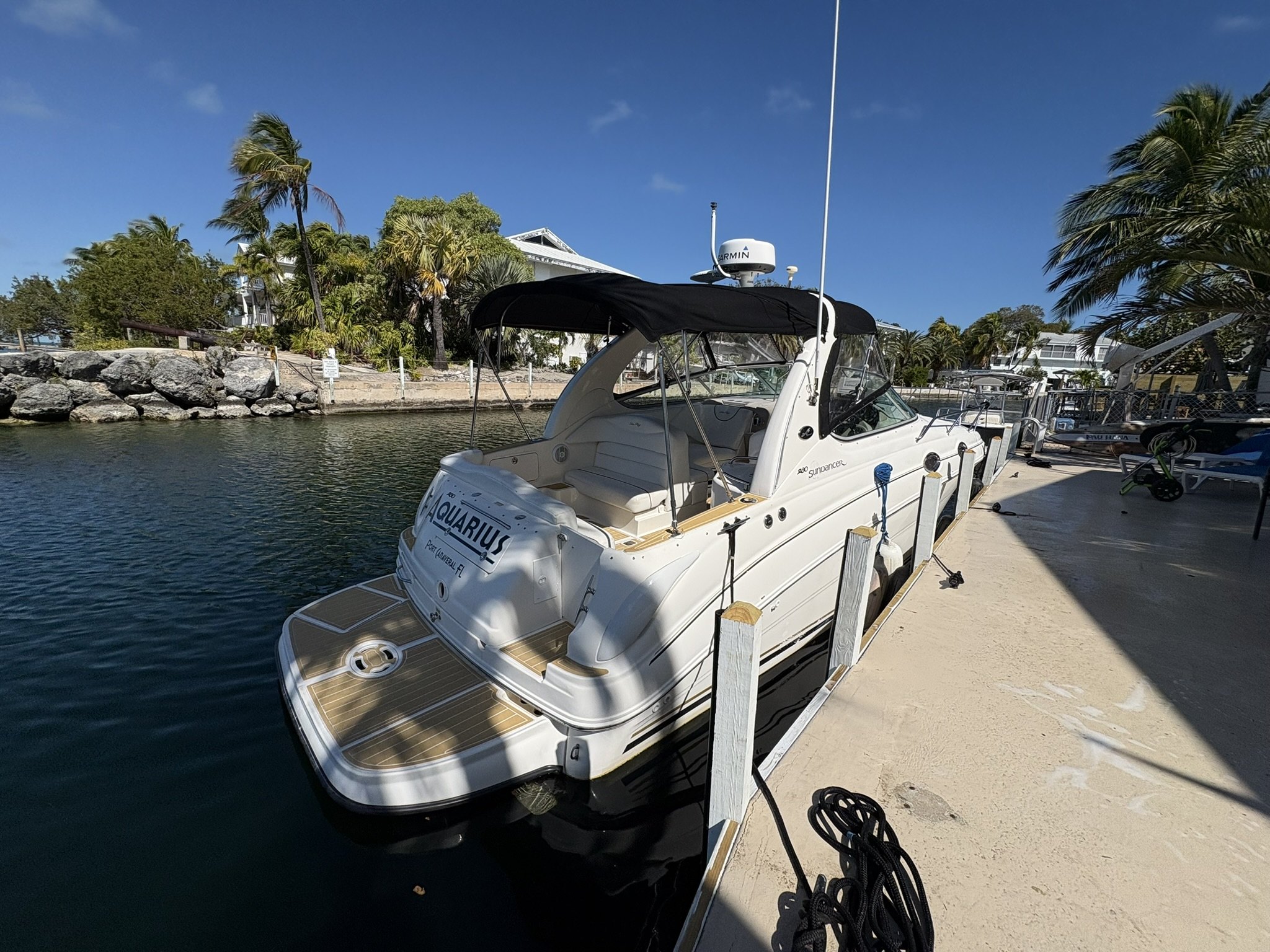
Keep it clean
Regular washes slow film reattachment between waterline services — boats on a consistent wash cycle need stain work less often.
Wash & wax plansIf it's oxidation
Chalky dull patches that won't lift with chemistry are oxidized gelcoat — correction restores them, cleaning can't.
Gelcoat restorationSeal the band
A coated waterline sheds film and weep far longer — coated boats need stain service a fraction as often.
Ceramic coatingCoverage
Dockside or on the lift, from Key Largo to Tavernier — including low-flow canal slips where film builds fastest.
Marinas, waterfront homes and private slips — including Bluefin Rock Harbor and Marina del Mar areas.
View Key Largo coverageHome base — Islamorada Yacht Village, Whale Harbor, Church Key and canal-front lifts.
View Islamorada coverageTavernier and Plantation Key, including Mangrove Marina slips and yard slots.
View Tavernier coverageFAQ
Send a daylight photo of the waterline band plus your length and where the boat is kept — slip, lift or yard. Buildup type and severity set the labor, and you receive a firm written quote before scheduling.
No. Hull and waterline service is limited to accessible above-waterline surfaces. We do not dive or clean propellers, shafts, thru-hulls or bottom paint. Below-waterline work needs a diver or haul-out — we're happy to point you to one.
Most Keys boats benefit from a waterline clean every 4–12 weeks depending on slip, water flow and season. Low-flow canal slips accumulate film fastest.
Not when used correctly. We use surface-safe marine stain removers, mask decals and stripes, and fully neutralize and rinse afterward. Unbuffered harsh acid left on gelcoat is what causes damage — we don't use it.
Most weep tracks lift fully with proper rust remover and dwell time. Where the source fitting continues to weep we note it in your completion report so it can be addressed — otherwise the stain returns. Deep pitting may need polishing.
Yes — that's the standard job. We work from the dock or swim platform at slip level, or on the lift when the boat is up. No haul-out required for anything above the waterline.
Yes. Wash & wax is full-surface maintenance with mild chemistry; waterline service targets bonded buildup and staining with stronger, surface-matched chemistry and dwell time. Most owners combine both in one visit.
Get started
Hull & Waterline Cleaning is already selected below. A daylight photo of the band lets us quote severity accurately.
Phone: 305-396-1787
Hours: Mon–Fri 8 AM–4:30 PM · Sat–Sun 8 AM–1 PM
Location: Islamorada, the Keys, MM 80 area